


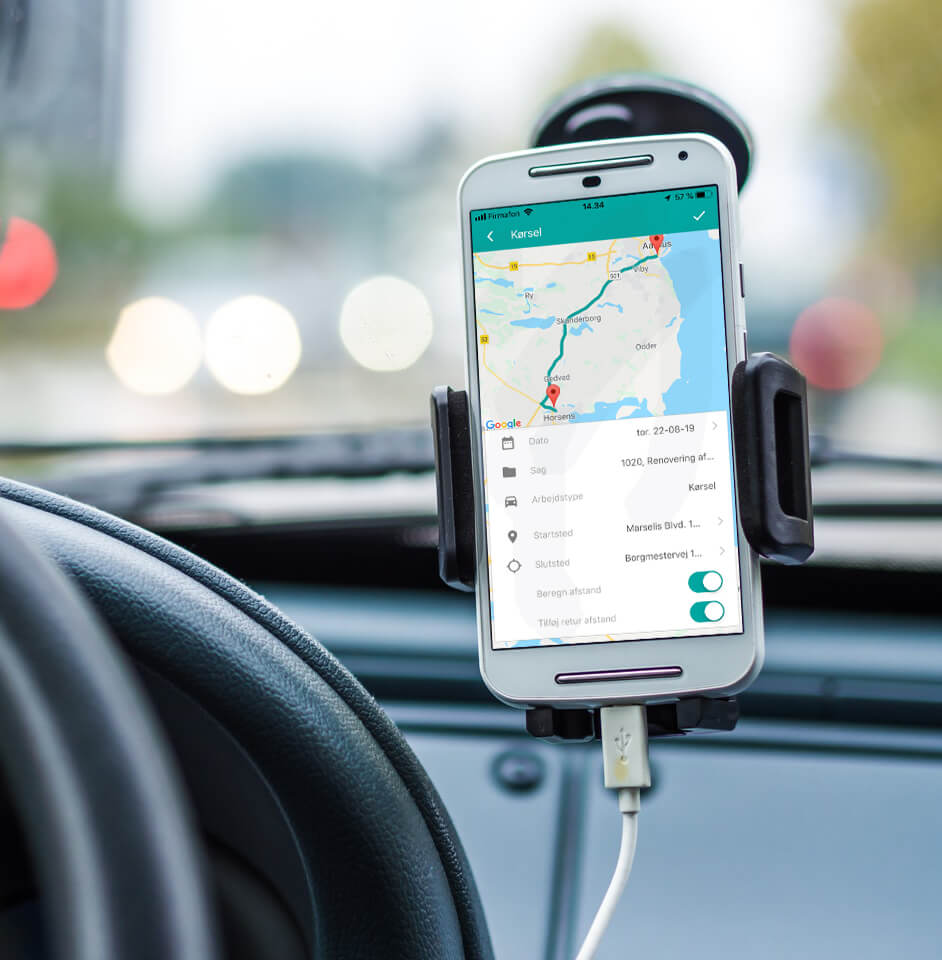
For most people, monitoring is probably a negatively charged word. People like to be left in peace. However, if you have nothing to hide, GPS monitoring can also be an enormously useful tool to make the workday easier and smarter. That's why Intempus has just launched two new GPS-based features. But is it employee monitoring?
How would you feel about your employer always being able to look at a map and see where you are while you're at work? That's probably quite individual, and indeed the case in many professions – for bus and taxi drivers, for example.
Intempus has in connection with Intempus 2.0 Two new features have just been launched; GPS tracking and geofencing. So, let's just come down from the helicopter and present them, before we fly back up into the heights and discuss the surveillance perspective.
GPS tracking
In Intempus 2.0, it is possible for the administrator to open a map showing the different employees‘ positions – even historically. The function is intelligently designed, so it only sends positions if the employee is moving, and it only works if the employee has actively pressed ’Start GPS tracking’ on the relevant submission.
Geofencing
Administrators can define a geographical area for each case. When the employee is then located within this area – and GPS tracking is enabled – Intempus will automatically record their working hours. Likewise, the recording will automatically end when the employee leaves the location. Subsequently, based on the collected data, Intempus will suggest a report, which the employee can then simply swipe to approve.
Why GPS tracking at all?
As this blog post has also touched upon previously, many work processes can be made smarter and easier through the use of GPS tracking. Therefore, we have joined forces with Intempus’ CEO and co-founder, Christophe Zafiryadis, so that we can truly understand the customer needs behind the two new features.
“It has long been part of a larger strategy to move away from time tracking. It may sound strange and should not be taken too literally. But customers will no longer have to track their own time – they just need to confirm the data that Intempus has automatically collected,” says Christophe Zafiryadis, adding that the ability to get assurance that the employee has been at a specific geographical location has been a major customer request.
In addition, one particular professional group has been a great inspiration for the work, which has left a significant mark on the daily life at Intempus for a considerable time.
“One of the major sources of inspiration for our geofencing feature has been those who carry out winter maintenance. That is, snow clearing and salting. They typically have a double-digit number of customers in one night, as each job often only takes 10-20 minutes. Therefore, it is a huge advantage that they do not have to search between their jobs, but are simply suggested a completed report ready for approval. They have also had a strong desire to be able to document their driving, as it can continue to snow after they have finished.”
“But it's really been an eye-opener, how many reports they make. Some of them have many thousands of active cases and could make an extremely high number of reports in one night,” says Christophe Zafiryadis.
Is surveillance morally acceptable?
Throughout the entire development process, a continuous discussion has taken place about how Intempus is developed so that it does not become a case of surveillance for surveillance's sake – and certainly not hidden surveillance. From the customers' side, there has been a desire to obtain documentation for the work carried out, just as the entire core of Intempus is to collect data about work performed by a person. This means that the entire strategy of increased automation is based on the premise of collecting data automatically, which can inevitably take on the character of surveillance. So, what answers have ultimately emerged from the internal discussion?
“The automatic GPS monitoring only takes place if the employee in question presses ‘Start GPS tracking’. This is entirely deliberate, because it means there is no question of whether the employee is aware that GPS monitoring is taking place. Intempus is not meant to be a surveillance system – it is meant to be a system that makes it easier to record one’s hours and document in black and white that one has performed one’s work,” says Christophe Zafiryadis.
“Then it must be up to the employer to tell the employee what the conditions are for them to be employed in that particular position,” he adds.
And there is room for changes – should it prove necessary.
“Initially, we feel that we have followed our core idea of how it should be, but now we have to see how the customers receive it. It's also a new feature for us, so we are certainly open to looking at any adjustments,” says Christophe Zafiryadis, adding that GDPR has contributed to an extra consideration of how the feature is put together.
And those buttons will continue to be tweaked. So, what are the plans going forward?
Even more automation
As mentioned, a clear strategy at Intempus is to push manual time tracking into the background – both analogue and digital. Data should be collected automatically as far as possible, and there are many thoughts on how this ambition can be realised to an even greater extent.
“We want to be able to help administrators with route planning. Let's say there are 50 routes in Copenhagen that need to be cleared of snow. How can they be distributed in the smartest way possible among the employees? Since we know where people are and where the problem is, we might be able to automate that part. This applies to many industries, but especially the transport sector,” says Christophe Zafiryadis, who sees one crucial reason why the time is ripe for the new Intempus features.
“The really big development is that the phone can now solve the technology in this. The possibility has been there for a long time, but previously required a wildly expensive GPS placed in a car.”
At the same time, Christophe Zafiryadis would like to lift the lid a little on what's in the pipeline at Intempus in the near future.
“There will be a feature that captures idle time. That is, the time between tasks. This is typically travel time, but the customer will be able to pre-define what that time should be registered as, thereby again reducing manual work,” he says.
And in the slightly longer term, the key to further automation might be hidden in the phone's calendar.
“Many consulting firms enter all their assignments into their calendars, so Intempus will gain some data which we can then use to generate suggestions for submissions that you will then just need to approve,” concludes Christophe Zafiryadis.
A digitised solution for the modern business
By implementing Intempus' digital time tracking solution, you can ensure that you maintain an overview of employees' varied working days, including their driving hours and different types of absence. Intempus also integrates with various payroll and accounting systems, allowing data to be transferred automatically from one system to another or with just a few clicks. An indispensable tool for the modern business, it will streamline administrative tasks for all employees – whether they are on the go or in the office.
Would you like to hear more? Then give us a call on +45 26390400 or book a free, no-obligation demo, where you can learn more about how we can meet your specific needs: