

Covid-19 has brought about many changes in our society. In particular, the way we structure our working lives has never been so much in flux as it is now. In this post, you can read about the home workspace and the requirements this places on both employees and companies.
Why the home office is gaining ground?
Although the pandemic has largely passed the country, working life has taken a turn towards ‘hybrid working’. More employees and workplaces have embraced the home office, and employees have become accustomed to the flexible working day.
Although there are disadvantages to working less in the office, where all informal knowledge sharing takes place, a majority still believe the benefits outweigh the drawbacks and that one to two days of working from home per week is preferable.
In analysis Good leadership has found that for employees given the freedom to plan their own tasks, working from home has a positive effect on their job satisfaction. Freedom is inextricably linked to trust, and in relation to working from home, it strengthens the framework for employees to have flexibility and self-determination in how they structure their workday.
Suitable for deep immersion
When individuals have the opportunity to organise their own work rhythm, there will also be a better work-life balance, and this flexibility is particularly valued by families. However, a balanced work life also means having variation in the framework, and although social interaction with colleagues is important for job satisfaction, some tasks require more peace and time for reflection than others. Many find the home office more optimal here, as it allows for better immersion in knowledge-based material due to fewer disturbances. Conversely, coordinating tasks require presence and are better suited to the office.
The flip side of the coin
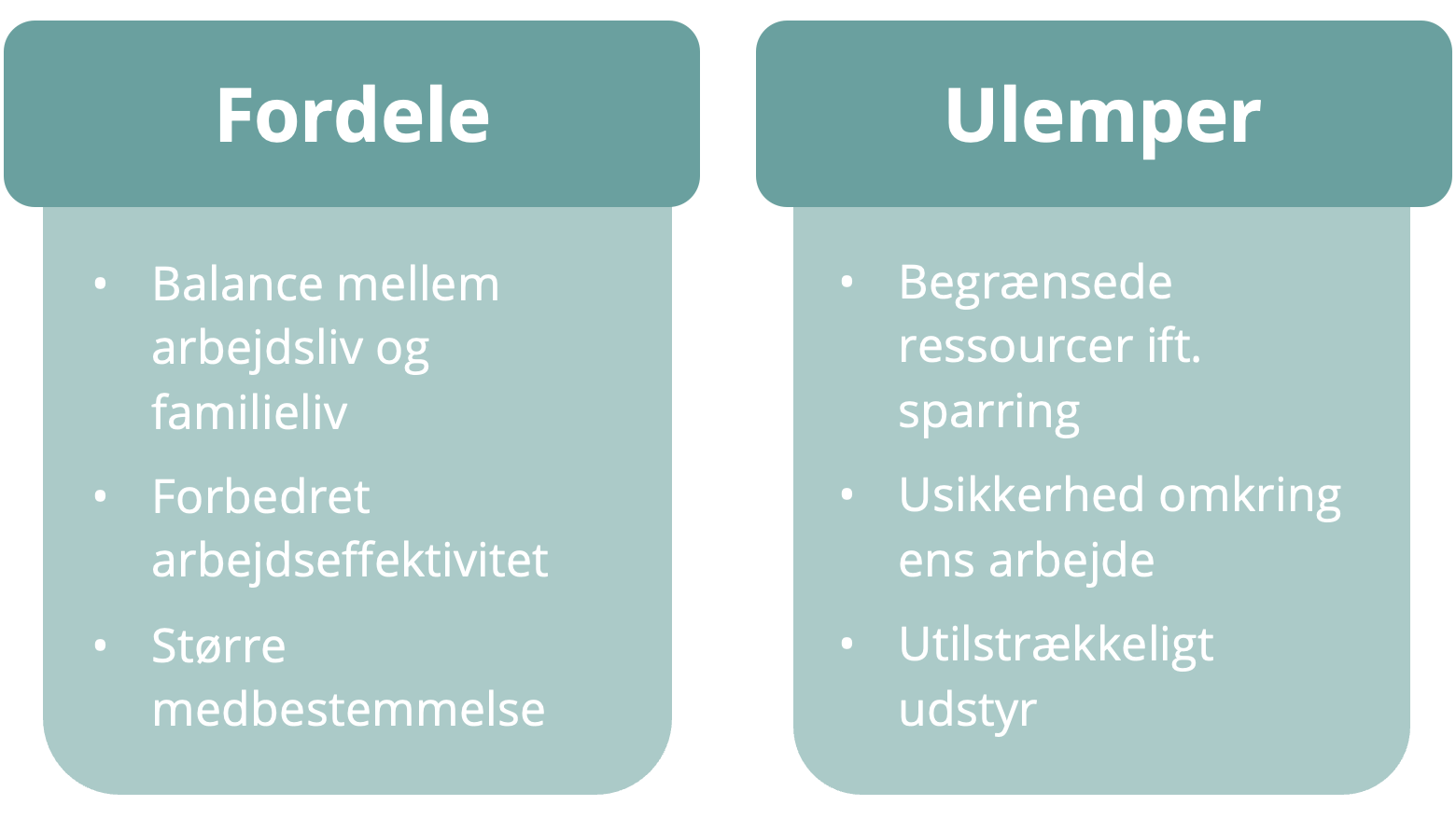
I studied from 2021 about working from home, ‘Six Key Advantages and Disadvantages of Working from Home in Europe during COVID-19, Three advantages and three disadvantages of the home workspace have been clarified based on statements from selected employees.
The benefits are, respectively, a balance between work and family life, improved work efficiency, and greater participation. This aligns with findings from a Danish study by Gallup and the aforementioned reasons. The drawbacks include limited resources for sparring, uncertainty regarding one's work, and insufficient equipment for the home office.
When the leader is absent and there's a lack of expectation alignment and trust, remote working cannot be as rewarding as it could be. This can sow uncertainty in the employee and, in the worst case, contribute to stress. Studies show this has been a direct consequence of forced remote working during Covid-19.
Forced home working and a high workload, combined with less access to colleagues and managers for sparring, are factors that have contributed to increased stress in workplaces. High flexibility places greater demands on an employee's ability to structure their time, as working from home lacks the same natural shift between work and leisure.
In some workplaces, the increased amount of homeworking following the pandemic has also led to an increased need for control from managers – at least if you ask the employees. In one survey, 17 percent of employees answer that they partially or fully agree that their immediate manager is more focused on control now than before Covid-19. This can help to weaken trust and thereby increase uncertainty among employees.
Lack of social interaction
One of the major drawbacks for employees is insufficient social interaction with their colleagues, which a majority of Danes feel affects their motivation for work. According to psychologist Malene Friis Andersen, this has contributed to feelings of loneliness: ‘Working from home can offer flexibility, freedom, and a better work-life balance, but also a lack of boundaries, conflicts at home, and the feeling of never being off. The home office allows for deep concentration, but can simultaneously increase feelings of loneliness and disconnection from the workplace.’
For leaders with employees working from home, the challenge is also to keep a sense of how they are doing. Teams meetings and virtual Friday bars can go a long way, but they cannot replace the informal encounters between leaders and employees.
What does the optimal new working life look like?
So what's the solution, one might be tempted to ask – and what is a sustainable working life? Employees may have different motivating factors, and the diversity of work tasks can mean that the way of working can vary.
There's no doubt that employees' physical presence in the workplace strengthens collaboration and cohesion. We're unlikely to move away from that. Some workplaces have also introduced days where everyone must come in, ensuring employees can interact and share knowledge. However, there's no doubt that hybrid working is here to stay.
For management, it is important to have completely clear agreements on who can work from home, which tasks can be carried out at home, as well as the framework and expectations for the work. First and foremost, it requires flexible management to handle the new reality of hybrid working from home and the office. The call from here must be to align expectations and make agreements on what types of work tasks can be handled from the home workspace. When you give your employees co-determination and responsibility for their own work rhythm, you will experience an efficient, dynamic, and trusting workplace.
A digitised solution for the modern business
By implementing a digital solution for time tracking in the workplace, you can ensure that you maintain an overview of employees' varied working days. The renewed and hybrid working life calls for mobile solutions in everyday life.
At Intempus, we have developed an intelligent app that gives employees ownership of their working day back, as they can register their hours and plan their working time themselves.
Would you like to hear more? Then give us a call on +45 26390400 or book a free, no-obligation demo, where you can learn more about how we can meet your specific needs:
Sources: Arbejdsmiljøweb.dk, Kantar Gallup & Knowledge Centre for Good Working Conditions